

Choosing Your Primary Total Knee Arthroplasty Implant: Beyond Common Beliefs
Today, I'd like to address a topic that, to quote Talleyrand, "goes without saying, but goes better by being said": how to choose a primary total knee prosthesis. Drawing from several publications and some experience, I want to share some common-sense ideas that might illuminate this crucial choice.
Pr PhilippeNeyret
Choosing Your Primary Total Knee Arthroplasty Implant:
Beyond Common Beliefs
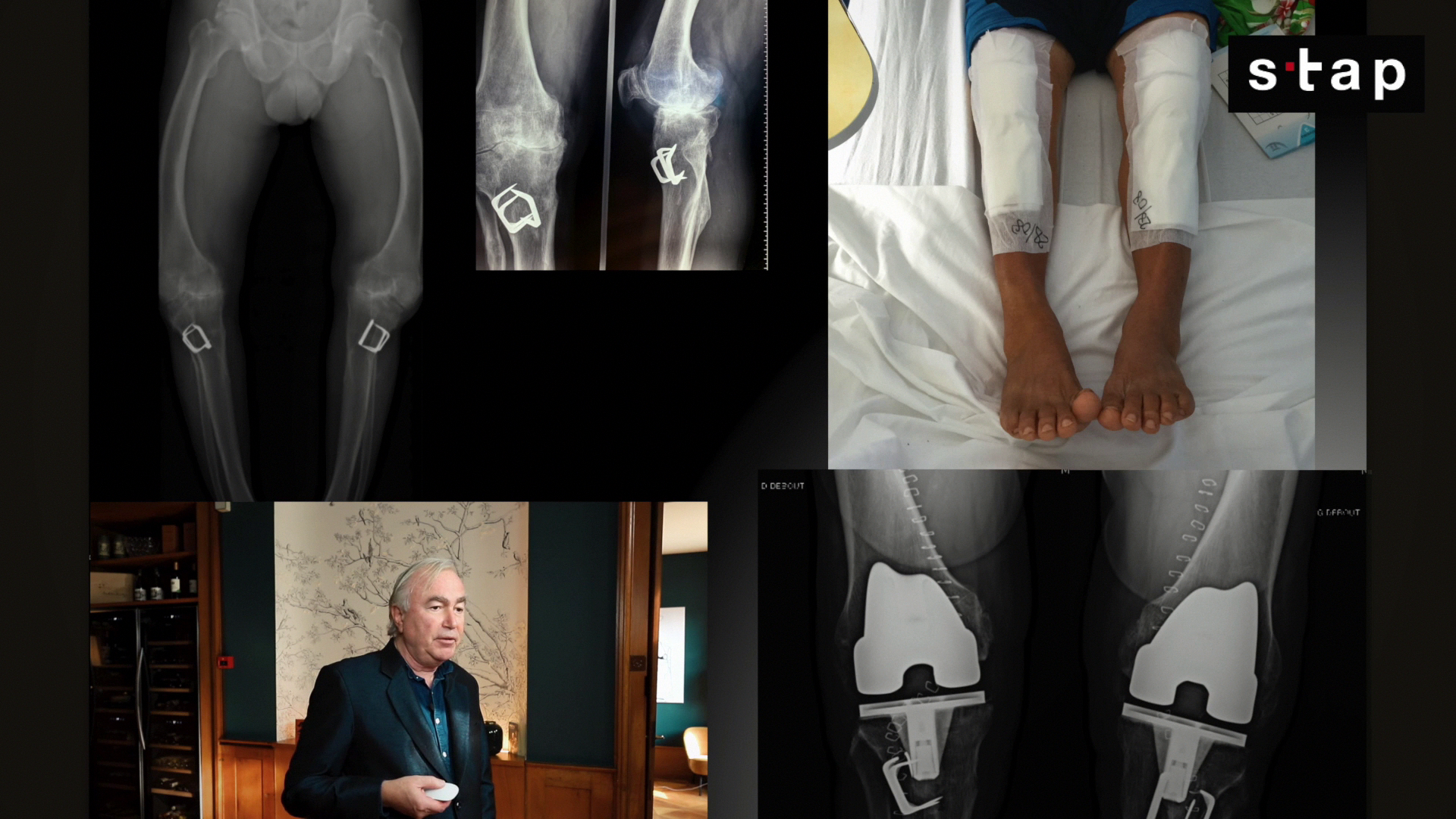
This excerpt is taken from the STAP course audio podcast, Chapter 1: The Surgeon’s Know-How, section 1.6 How to Choose a Primary Total Knee Prosthesis
What Doesn't Make a Difference (or Isn't Scientifically Proven Yet)
Scientific literature is full of comparisons, but certain frequently debated aspects don't show major differences in the short and medium term.
- Posterior Cruciate Ligament (PCL): Whether the prosthesis preserves or sacrifices it, the results are similar according to the literature.
- Medial Pivot or Deep-Dish Design: No notable difference, if we believe the literature.
- Mobile-Bearing vs. Fixed-Bearing Prosthesis: Results are fairly similar, with no significant difference according to the literature.
- Cementless vs. Cemented Prosthesis: While generally no major difference, there is probably a small difference concerning the tibial component, which may need to be cemented in certain circumstances.
- Patellar Resurfacing: Again, no major difference, at least in the short and medium term.
- Patient-Specific Guides, Computer-Assisted Navigation, Robotics: Compared to traditional mechanical methods, they are not superior in most cases. However, questions may arise regarding their use for unicompartmental knee prostheses, where some caution might be warranted.
- Custom-Made Prostheses: While they might seem appealing (like haute couture), they involve higher costs, longer lead times, and the need for a "back up" plan. The literature shows no clear superiority compared to traditional "ready-to-wear" prostheses.
It's important to note that the absence of a proven difference does not mean there is none; it may simply indicate that our current analysis parameters (revision rates, patient scores) are not sufficiently discriminating. Many of our choices, therefore, stem more from beliefs or convictions than from established scientific realities.
So, What Truly Matters?
If the technical aspects mentioned above are not always decisive, other elements are essential for an optimal outcome and robust surgery.
1. The Implant Itself: Versatility and Adaptability
Rather than using many different implants (which is costly and a source of confusion for the surgical team), it is preferable to choose one primary implant and master it. This implant should meet several criteria:
- Compatible Trochlea: Allow for not resurfacing the patella.
- Good Femur-Tibia "Matching": Not be limited to only one size difference.
- Great Versatility: The ability to switch easily from a less constrained implant to a more constrained one. Some companies have developed implants that allow a very simple transition between constraint levels.
- Extensive Range: Be part of a wide product line to avoid "oversizing" (a prosthesis that is too large) and ensure a suitable mediolateral ratio, especially for smaller sizes. The U2 prosthesis is cited as an example, having a good design and, importantly, a wide range of implants.
- Forgiveness ("A forgiving prosthesis"): Given the lack of consensus on the ideal alignment (kinematic, mechanical, anatomical, etc.), a prosthesis capable of accepting positioning with one to three degrees of variation is paramount, as no one can determine the exact target with absolute precision.
- Extended Tibial Stem Option: The possibility of using an extended tibial stem on a primary prosthesis is an advantage.
In essence, it is more important to achieve a personalized and tailored indication for the patient rather than a custom implant.
2. Instrumentation: Precision and Robustness
An implant must be forgiving and versatile, but to implant it, good, precise, and reliable instrumentation is necessary.
- Versatile Femoral Guides: Guides that allow adjustment of anteroposterior positioning, rotational changes, and precise cuts adapted to the patient’s original anatomy.
- Combined Tibial Guides: The combination of intra- and extramedullary guides is essential. This allows adapting the cut and insertion of stems without altering bone cuts, even in severely deformed tibias. An intramedullary guide alone might be problematic in some cases, while it is useful for obese patients without bone deformity.
- Robust Surgery: Instrumentation must enable robust surgery, meaning surgery that can be performed under practically all circumstances. Operating conditions are never ideal: the surgeon might be tired, the team changed, the patient thin or obese, with slight or severe deformities, a hyperlax or very stiff knee. The instrumentation must be able to adapt to all these situations.
3. Partnership with Industry: More Than Just a Product
The choice of an implant is also the choice of a company. It is no longer just a supplier of plastic and metal, but a true partner that supports the surgeon and patient within an entire ecosystem.
- Service and Responsiveness: The company must offer excellent service and after-sales support, be responsive, and provide all necessary implant sizes.
- Flexibility and Local Ethics: Respect the local ethics of the country, not just international company standards.
- Commitment to Education and Acceptable Pricing: Invest in education and offer prices adapted to the local situation.
- Shared Strategy: Ideally, it is good to share the company's strategy for a better mutual understanding of interests.
- The Technological Ecosystem: Nowadays, companies sell a complete concept, including IT environments and robotics (like Think Surgical, Zimmer's ecosystem, Smith & Nephew's Real Intelligence, Stryker), which are integral to the decision.
The Central Role of the Surgeon
The surgeon has a key responsibility in this process.
- Less Experienced Surgeon: It is recommended to start by using the implants learned during training for about two to three years before gradually evolving.
- Experienced Surgeon: Often prefers a "highway," meaning simple, reliable, and reproducible surgery, especially with a high volume of activity.
- Progressive Introduction of New Implants: When changing implants, it is crucial to introduce them gradually into practice, testing and evaluating their results in the best interest of patients.
- Asserting One's Choice: The surgeon must assert their choice of implants and in their relationship with the industry, not leaving this decision to administrations or financial systems.
The Patient at the Core of the Decision
Ultimately, the patient is at the center of the problem and the decision. A comprehensive and holistic approach to surgery is necessary, understanding the close links between instrumentation, implant design, biomaterials, and the type of stabilization.
Although regulations (FDA, ANVISA, EU) ensure the reliability of implants available on the market, it is the surgeon's responsibility to make the right choices. These choices must be guided by criteria such as versatility, reproducibility, a broad range of implants, robustness, ethics, and a good partnership.
I hope these insights help you better understand the complexities and priorities in selecting a total knee prosthesis, to always provide the best care for your patients.

 STAP Interviews-Testimonials
 Managing Complex Personalities in Consultations: Keys to Calm Communication (Interview with Dr. Mathias Campins)
 Comment choisir une prothèse totale de genou de première intention